
When sourcing high purity lysergamides for research, the quality of your compounds directly determines the validity of your findings. For the serious researcher, these compounds serve as analytical reference standards, tools for receptor pharmacology, and substrates for structure-activity relationship studies. However, even minor impurities can confound analytical results, introduce artifacts in receptor binding assays, and compromise the integrity of metabolic studies.
This guide examines the key criteria for evaluating high grade lysergamides for research – purity verification, analytical characterization, potency data, and application-specific considerations to help researchers make informed sourcing decisions.
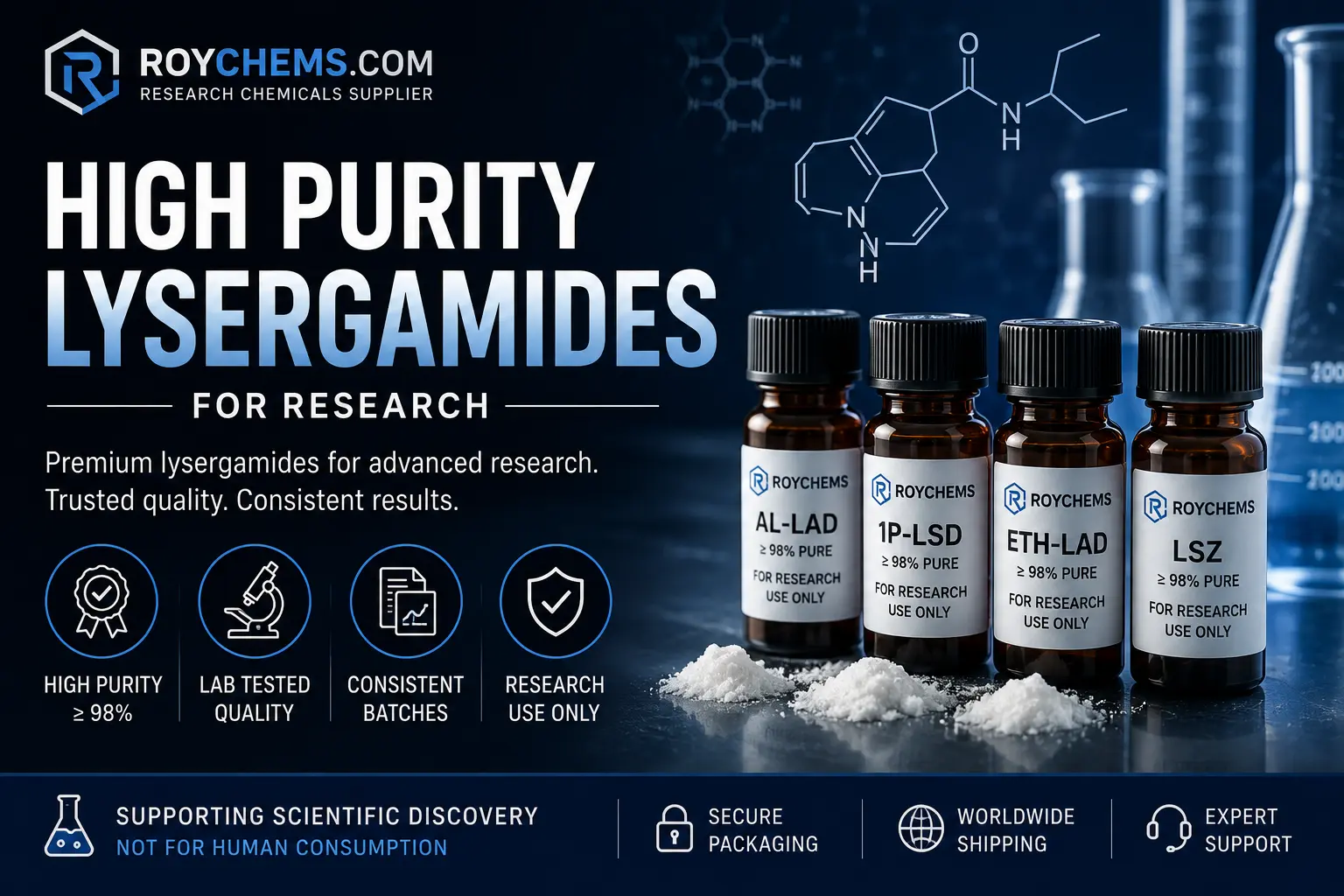
Understanding the Lysergamide Landscape
The lysergamide class is defined by the tetracyclic ergoline ring system, a complex structure that forms the backbone of numerous natural and synthetic compounds. This core scaffold, which includes an indole nucleus fused to a quinoline moiety, is what gives these molecules their unique spectroscopic fingerprint and pharmacological properties.
Modern lysergamides for research span several structural categories:
N-Acyl derivatives such as 1P-LSD, 1cP-LSD, 1B-LSD, and 1V-LSD represent compounds modified at the indole nitrogen position. These are of particular interest for prodrug studies and forensic reference work.
6-Substituted norlysergamides including AL-LAD, ETH-LAD, and PRO-LAD feature modifications at the N6 position of the ergoline ring, which significantly affect receptor binding and behavioral potency.
Constrained analogs like LSZ (lysergic acid 2,4-dimethylazetidide) incorporate sterically rigidified structures designed to probe the receptor binding pocket with greater precision.
The Critical Importance of Purity Verification
Purity is not simply a number on a certificate – it is the foundation upon which reliable research is built. In lysergamide chemistry, even minor impurities can confound analytical results, introduce artifacts in receptor binding assays, and compromise the integrity of metabolic studies.
A recent analytical investigation of a commercially available lysergamide sample revealed the detection of 17 impurities based on high-resolution tandem mass spectral data. Among these, multiple oxidation products and synthetic byproducts were identified, highlighting the complex impurity profiles that can arise during synthesis and storage.
The detection of AL-LAD and 1P-AL-LAD in samples sold as 1cP-AL-LAD further underscores the importance of rigorous analytical verification. Cross-contamination or misidentification can render research findings questionable at best.
What to Look for in Product Documentation
When evaluating a source for top grade lysergamides for research, the following documentation standards are essential:
-
Identity confirmation using orthogonal analytical techniques, ideally including Nuclear Magnetic Resonance (NMR), High-Resolution Mass Spectrometry (HRMS), Infrared (IR) spectroscopy, and chromatographic methods (HPLC, GC).
-
Purity assessment with quantitative methods such as HPLC-DAD or qNMR, with clear reporting of purity percentage and detection limits.
-
Batch-specific traceability linking each product shipment to a unique certificate of analysis (CoA).
-
Impurity profiling identifying and quantifying major impurities, degradation products, and residual solvents.
-
Storage and stability recommendations because lysergamides are prone to degradation under improper conditions (light, heat, moisture).
Evaluating Potency: Data-Driven Insights
For researchers working with pharmacological or behavioral assays, understanding the potency differences between lysergamide analogs is critical. These differences are not arbitrary – they reflect fundamental structure-activity relationships that inform our understanding of receptor pharmacology.
Comparative Potency Data
In vivo behavioral assays using the head-twitch response (HTR) in mice – a validated proxy for 5-HT2A receptor activation – have quantified potency differences across multiple lysergamides:
| Compound | ED50 (nmol/kg) | Relative Potency (vs. LSD) |
|---|---|---|
| LSD | 132.8 | 1.0x |
| LSZ | 114.2 | ~1.2x (equipotent) |
| AL-LAD | 174.9 | ~0.76x (slightly less potent) |
LSZ was found to be equipotent to LSD, whereas AL-LAD was slightly less potent. These data demonstrate how subtle structural modifications – the substitution of the diethylamide group with a constrained azetidine ring in LSZ – can dramatically influence pharmacological activity.
Receptor Binding Profiles
Quantitative binding data further refine our understanding of lysergamide pharmacology. For example, lysergamide (LSA) exhibits significantly lower binding affinity at serotonin 5-HT1A and 5-HT2 receptors compared to LSD, with a potency reduction of approximately 27-fold for the 5-HT2A-mediated response.
The importance of stereochemistry is equally evident. Studies of lysergic acid amides with chiral alkyl groups have demonstrated that the (R)-configuration can confer approximately 20-fold greater functional activity at the 5-HT2A receptor compared to the (S)-isomer.
N-Acyl Prodrug Considerations
For N-acylated lysergamides such as 1P-LSD and 1cP-LSD, the relationship between structure and potency is further complicated by prodrug dynamics. These compounds are believed to undergo deacylation to release the active parent compound, meaning that potency differences may reflect both intrinsic activity and metabolic conversion rates.
Application-Specific Quality Requirements
Different research chemical applications demand different levels of quality assurance when sourcing lysergamides for research.
Forensic and toxicological analysis requires certified reference materials with comprehensive impurity profiling and demonstrated stability under storage conditions relevant to casework.
Receptor pharmacology studies demand compounds of the highest achievable purity (typically ≥98%) with confirmed identity and demonstrated absence of interfering contaminants that could produce artifactual results.
Synthetic chemistry and intermediate preparation may tolerate lower purity specifications but require full characterization of the product to ensure reproducibility.
Practical Guidance for the Researcher
When sourcing high-purity lysergamides for research, consider the following approach:
-
Verify documentation before ordering. A reputable supplier should provide access to batch-specific CoAs with identity confirmation via multiple analytical methods.
-
Assess the supplier’s expertise. Suppliers that demonstrate understanding of the analytical requirements—including NMR, MS, IR, and chromatographic analysis—are more likely to provide reliable lysergamides for research.
-
Consider the product form. Blotter samples are notoriously difficult to quantify and characterize due to uneven distribution and matrix interference. Powdered and crystalline forms are generally preferred for analytical work.
-
Evaluate the impurity profile. Even with high stated purity, the specific impurities present can affect research outcomes. Suppliers that can identify and quantify impurities provide greater value than those reporting only a single purity percentage.
-
Document storage conditions. Lysergamides are susceptible to degradation. Adherence to recommended storage conditions (typically −20°C or −80°C, light- and moisture-protected) is essential.
Conclusion
The value of high-purity lysergamides for research is directly proportional to the quality of the compounds used. For the serious investigator, purity and analytical characterization are not optional—they are prerequisites for generating data that can be trusted, replicated, and built upon.
The detection of multiple impurities in commercial lysergamide samples serves as a cautionary tale: appearance and stated purity are insufficient guarantees. Rigorous analytical verification, backed by comprehensive documentation, is the hallmark of a trustworthy source for high grade lysergamides.
By understanding what distinguishes a quality lysergamide product – identity confirmation, impurity profiling, batch traceability, and application-appropriate purity – researchers can make sourcing decisions that support the integrity of their work. The compounds themselves are powerful tools; the rigor applied to their evaluation determines whether that power is channeled into productive research or lost to poor quality and questionable data.